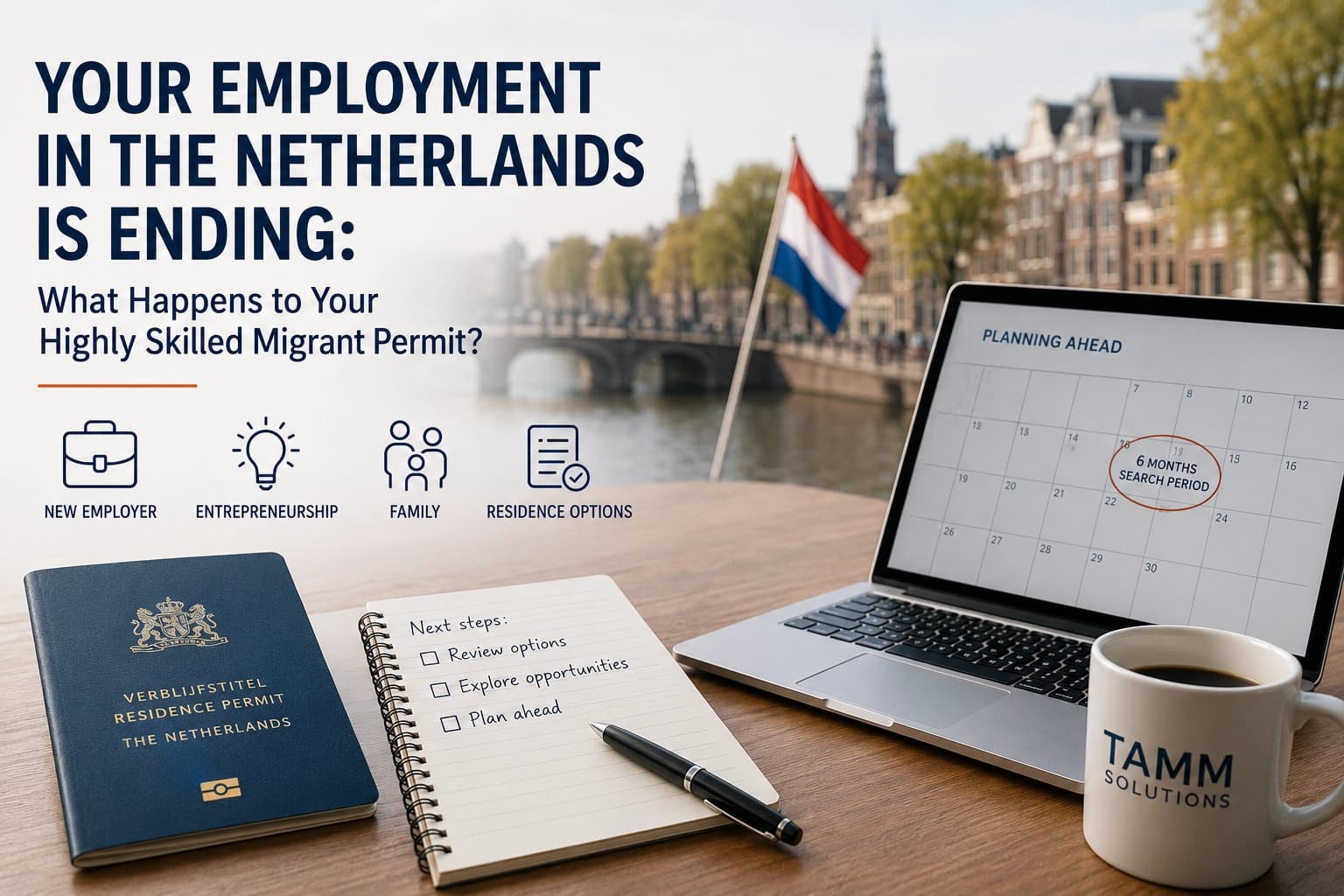
Your Employment in the Netherlands Is Ending: What Happens to Your Highly Skilled Migrant Permit?
Is your Dutch employment ending while you hold a highly skilled migrant permit? Understand how a new employer, entrepreneurship or another residence route may affect your stay.
Reading time: 6 minutes
Published: 2 August 2026
Prepared by the Advisory Team at TAMM Solutions
Executive Summary
The end of employment can create considerable uncertainty for a highly skilled migrant in the Netherlands. One of the first concerns is often whether it is still possible to remain in the country and continue working.
The answer depends on several factors, including the formal employment end date, the remaining validity of the residence permit, the period for which the permit has been held and whether another qualifying residence route is available.
For some professionals, securing employment with another recognised sponsor will be the most appropriate solution. Others may decide to establish a business, rely on a different residence category or reconsider their longer-term plans in the Netherlands.
Understanding the available options before making important decisions can help preserve flexibility and reduce unnecessary uncertainty.
At a Glance
The end of employment does not automatically require departure from the Netherlands.
A limited search period may be available, depending on the applicable immigration rules and the validity of the residence permit.
Joining another recognised sponsor is one possible route, but it may not always be the most suitable solution.
Entrepreneurship or another residence purpose may be appropriate in certain circumstances.
Employment, immigration, corporate and family considerations should be reviewed together before significant decisions are made.
Employment Termination Has Wider Consequences
For a highly skilled migrant, the conclusion of an employment relationship is rarely only an employment matter.
Residence under the Dutch highly skilled migrant scheme is generally linked to qualifying employment with an employer recognised by the Immigration and Naturalisation Service (IND). When that employment ends, the individual must consider both the next professional step and the continuing legal basis for living and working in the Netherlands.
Employment may end for many reasons, including:
restructuring or redundancy;
a settlement agreement;
expiry of a fixed-term contract;
dismissal during probation;
resignation; or
a personal decision to pursue entrepreneurship.
Although these situations result in the same practical outcome—the end of employment—they do not necessarily create the same legal or strategic position.
The legal termination date is particularly important because the immigration search period begins when the employment contract officially ends. A final working day or release from duties does not necessarily mean that the employment relationship has already terminated.
Does Employment Termination Mean Immediate Departure?
Not necessarily.
A highly skilled migrant whose residence permit remains valid may have a limited period in which to secure new qualifying employment.
Under the rules applying from 22 May 2026, the search period is generally up to three months. A highly skilled migrant who has held the permit for at least two years may have up to six months to find new qualifying employment. The search period cannot continue beyond the expiry date of the existing residence permit. Different treatment may apply where employment ended before 22 May 2026, and the individual position should therefore be confirmed.
This means the theoretical maximum is not always the period actually available.
For example, a person whose residence permit expires shortly after employment ends may have considerably less time than someone whose residence permit remains valid for another year.
The practical question is therefore not simply whether three or six months are available. It is whether sufficient time exists to complete the most appropriate next step.
Early assessment is often valuable because changing employer, establishing a business or applying for another residence purpose may each involve different preparation.
Joining Another Recognised Sponsor
For many highly skilled migrants, securing employment with another recognised sponsor remains the most direct solution.
Prospective employees can verify whether an organisation is listed in the IND's public register of recognised sponsors. The new position must also satisfy the applicable requirements of the highly skilled migrant scheme.
However, accepting another position should not be viewed solely as a way to preserve residence.
Important considerations include:
whether the position supports long-term career objectives;
whether the employer is an appropriate recognised sponsor;
whether the salary and employment conditions satisfy the applicable requirements;
whether the transition can realistically be completed within the available search period; and
whether remaining in employment continues to reflect the individual's wider professional ambitions.
For some professionals, another employer will clearly be the best option.
For others, the end of employment may represent an opportunity to pursue a business idea that has already been under development.
Entrepreneurship May Become the Next Step
An increasing number of highly skilled migrants consider entrepreneurship after leaving employment.
Some individuals have already developed a consultancy practice, technology business, trading activity or other commercial concept while employed. Others have identified clients, prepared a business plan or decided that self-employment better reflects their long-term ambitions.
Where this is the case, employment termination may simply accelerate an existing plan.
However, establishing a Dutch company or registering with the Chamber of Commerce does not automatically provide a legal basis to remain in the Netherlands.
Individuals wishing to reside as entrepreneurs must qualify under the appropriate residence category.
Submitting an application to change residence purpose does not automatically mean that unrestricted work as an entrepreneur may begin immediately. The residence and work position during a pending application should therefore be confirmed separately.
When evaluating entrepreneurship, several issues should be considered, including:
the commercial viability of the proposed business;
available clients and expected income;
the most appropriate corporate structure;
available investment;
timing of the residence application; and
the individual's longer-term commercial objectives.
For qualifying nationals, the Dutch-American Friendship Treaty (DAFT) or the Dutch-Japanese Trade Treaty may provide an appropriate entrepreneur route, subject to the applicable residence, business and investment requirements.
Entrepreneurship should therefore be approached as a genuine long-term professional strategy rather than simply as an immediate response to the end of employment.
Residence Planning Extends Beyond Employment
Changing employer or establishing a business are not the only options available when employment comes to an end.
Depending on the individual's circumstances, another residence purpose may provide a more appropriate long-term solution. This may include residence with a spouse or partner, an orientation year for qualifying graduates or researchers, another employment-related residence category, permanent residence, long-term EU residence or another route linked to nationality or personal circumstances.
Each residence category has its own legal requirements and should be assessed individually. The most suitable option is not necessarily the one that appears to be the quickest administrative solution, but the one that best supports the individual's longer-term professional and personal objectives.
Residence planning should also extend beyond the principal permit holder.
Partners and children may have residence rights connected to the highly skilled migrant's status. A change affecting the principal permit holder may therefore influence the wider family, including employment opportunities, education, financial planning and future residence arrangements.
Considering these wider implications at an early stage often helps prevent unnecessary complications later.
Settlement Agreements and Immigration Timing
Where employment ends through a settlement agreement, attention should extend beyond the financial terms.
The agreed legal termination date frequently determines when the immigration search period begins. It may therefore influence the time available to secure another recognised sponsor, prepare an application for another residence purpose or consider entrepreneurship.
For this reason, employment and immigration consequences should be considered together before a settlement agreement is finalised.
A proposal that appears commercially attractive may not necessarily represent the strongest overall outcome if its timing restricts future residence or professional opportunities.
We discuss settlement agreements in greater detail in our related Insight:
Settlement Agreement in the Netherlands: Should You Sign It?
Planning the Next Step
Every situation should be assessed on its own facts, but the following considerations often assist in determining the most appropriate direction.
Joining another recognised sponsor
For many highly skilled migrants, securing employment with another recognised sponsor remains the most straightforward solution. The principal consideration is whether the employer satisfies the applicable immigration requirements and whether the transition can be completed within the available search period.
Establishing a Dutch business
Entrepreneurship may represent an appropriate next step for individuals who have already developed a viable business concept or independent client base. Before proceeding, the proposed business structure, residence position and commercial viability should be assessed together.
Changing residence purpose
Another residence category may better reflect an individual's longer-term objectives. Depending on the circumstances, this may include residence with a partner, permanent residence, long-term EU residence or another qualifying residence route.
Family planning
Where family members depend on the principal permit holder's residence status, employment termination may affect more than one person. Reviewing the family's overall position at an early stage often provides greater certainty and allows decisions to be coordinated.
There is no universal solution.
The most appropriate strategy depends on the individual's residence history, employment circumstances, professional ambitions and family situation.
An Integrated Perspective
One of the most common misconceptions is that the end of employment creates only an immigration issue.
In practice, employment termination often involves several interconnected areas of law and business, including employment, immigration, corporate structuring, financial planning and family considerations. Decisions made in one area may influence opportunities in another.
For international professionals, an integrated assessment frequently provides a stronger basis for decision-making than considering each issue independently.
Conclusion
The end of employment does not necessarily determine the end of a highly skilled migrant's future in the Netherlands.
Depending on the circumstances, another recognised sponsor, entrepreneurship or a different residence purpose may each represent an appropriate way forward. The correct solution will depend not only on the applicable legal framework, but also on the individual's longer-term professional and personal objectives.
Early planning enables important decisions to be made from a position of understanding rather than urgency.
If your employment is ending while your residence depends on highly skilled migrant status, the timing of your next decision may materially influence the options available.
TAMM Solutions provides coordinated advice across Dutch employment, immigration and corporate matters, helping international professionals evaluate their position before important decisions are made.
If you would like to discuss your circumstances confidentially, our team would be pleased to assist.
Related Insights
You may also find the following Insights helpful:
Settlement Agreement in the Netherlands: Should You Sign It? | TAMM Solutions
How to Set Up a Company in the Netherlands: A Complete Guide for Foreign Entrepreneurs
DAFT Visa for the Netherlands: A Practical Path for U.S. Entrepreneurs
Moving to the Netherlands with an EU Long-Term Residence Permit: What You Need to Know
Disclaimer
This publication provides general information only and does not constitute legal, immigration, employment, corporate, financial or tax advice. The appropriate course of action depends on the individual circumstances and the legislation and policy applicable at the relevant time.