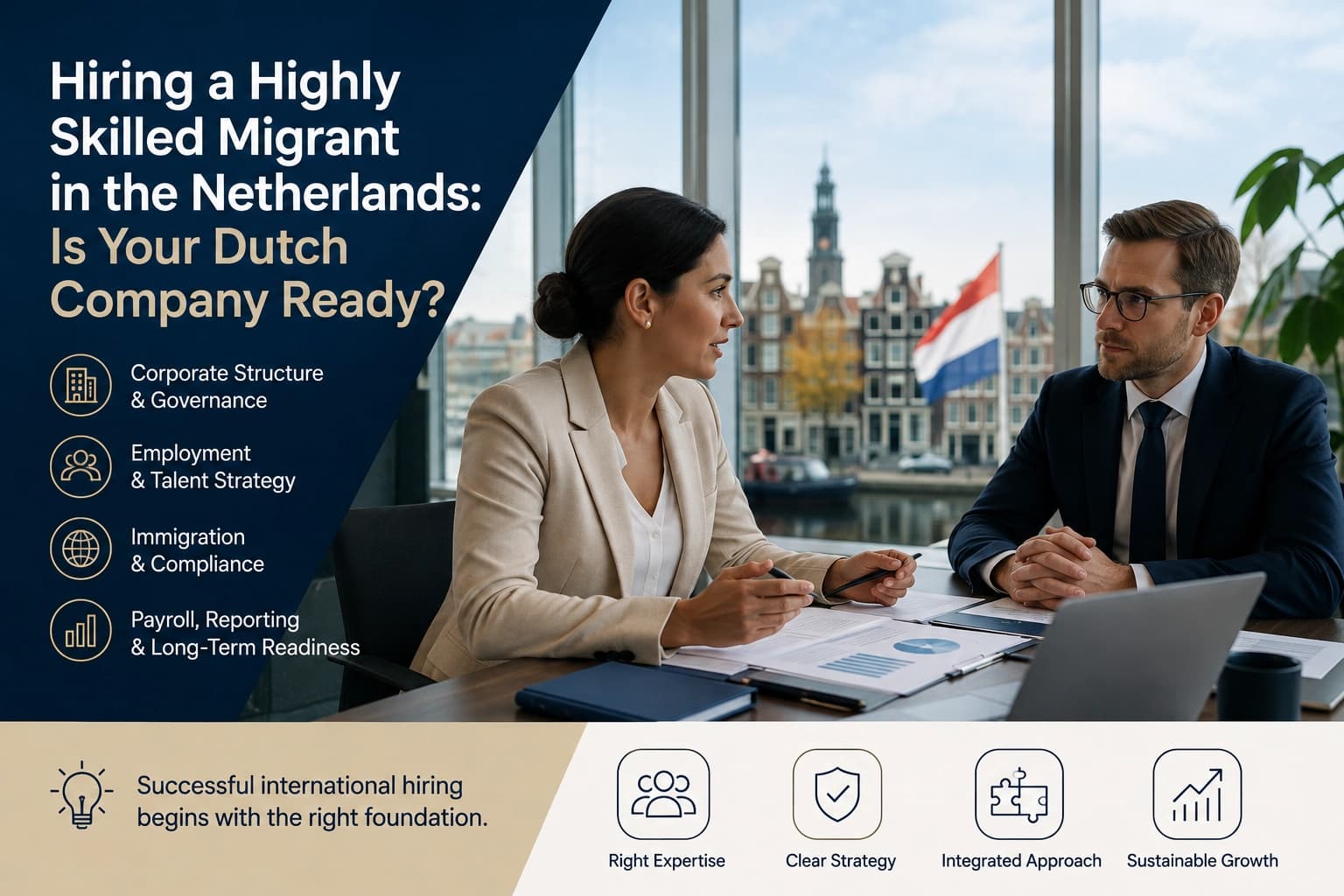
Hiring a Highly Skilled Migrant in the Netherlands: Is Your Dutch Company Ready?
Hiring a highly skilled migrant in the Netherlands involves more than immigration. Discover the corporate, employment, payroll and compliance challenges Dutch businesses should consider before relocating international talent.
Incorporating a Dutch Company Is Often the Easy Part
International expansion usually begins with a clear commercial objective.
A business decides to establish a Dutch presence, relocate a trusted employee and start serving the European market.
The natural assumption is that once the Dutch company has been incorporated, the next step is simply arranging the employee's residence permit.
In practice, this is where many businesses discover that immigration is only one element of a much broader legal and operational picture.
The real question is often not whether the employee qualifies to relocate.
It is whether the Dutch business is genuinely ready to employ them.
International Hiring Is a Business Decision Before It Becomes an Immigration Matter
When companies think about hiring international talent, they often focus on immigration requirements.
In reality, successful international recruitment begins much earlier.
Management should first ask whether the Dutch operation has been designed to support long-term growth.
For example:
Does the Dutch entity have a clearly defined business purpose?
Who will actually manage the Dutch operation?
Does the proposed role reflect genuine business needs?
Is the governance structure appropriate?
Are employment, payroll and reporting responsibilities clearly allocated?
These are commercial questions with legal consequences.
Businesses that address them early usually experience a smoother expansion than those treating immigration as a standalone process.
The Corporate Structure Should Support the Business Strategy
A newly incorporated Dutch company may look complete on paper.
However, incorporation alone rarely answers the questions that become important once employees, investors and customers are involved.
As the business develops, management may need to reconsider:
decision-making authority;
board responsibilities;
shareholder involvement;
funding arrangements;
intercompany relationships;
operational control.
A structure that works for incorporation may no longer support the business once it begins employing staff and expanding internationally.
Hiring International Employees Creates Ongoing Responsibilities
Relocating a key employee is rarely a one-off event.
It creates an ongoing relationship involving employment law, immigration compliance, payroll administration and corporate governance.
Changes that appear purely commercial—such as restructuring, appointing new directors, changing ownership or reorganising the business—may also affect the employer's legal obligations.
For that reason, international recruitment should be viewed as part of the company's overall growth strategy rather than simply an HR exercise.
Founders Often Face Different Challenges Than Established Businesses
For founder-led businesses, the legal analysis can become more nuanced.
Many entrepreneurs assume that because they own the company, they can simply appoint themselves as director and relocate through the business.
In reality, the relationship between ownership, management and employment deserves careful consideration.
The appropriate structure depends on the wider corporate framework rather than on a single document or job title.
This is one of the reasons why international founders often benefit from considering corporate and immigration planning together rather than separately.
Planning Early Creates More Options
One of the most common mistakes is waiting until an employee has accepted the position before considering the wider legal framework.
At that stage, commercial deadlines may already have been agreed, relocation plans may be underway and expectations have been set.
Early planning provides greater flexibility.
It allows businesses to consider whether:
the chosen corporate structure remains appropriate;
governance arrangements support future growth;
employment documentation reflects commercial reality;
immigration strategy aligns with long-term business objectives.
These discussions are often considerably easier before commitments have been made.
International Expansion Should Be Viewed Holistically
The most successful international businesses rarely treat incorporation, employment, immigration and compliance as separate projects.
Instead, they view them as interconnected parts of the same expansion strategy.
When these areas are aligned from the outset, businesses are generally better positioned to grow, attract investment and adapt as the organisation evolves.
Conversely, addressing issues only after expansion has begun can result in unnecessary complexity, additional costs and avoidable delays.
Questions Management Should Ask Before Relocating Key Employees
Rather than focusing solely on the immigration process, management may wish to consider:
Does our Dutch structure support the business we intend to build?
Have we clearly allocated management responsibilities?
Is the employment arrangement consistent with the corporate structure?
Are payroll, compliance and reporting organised?
Could future investment or expansion require changes to the current structure?
Have we considered how future restructuring or organisational changes may affect international employees?
These questions rarely have standard answers, but they often determine how smoothly an international expansion progresses.
Conclusion
Relocating international talent is often viewed as an immigration matter.
In practice, it is usually a business structuring exercise that also involves corporate governance, employment law, compliance and operational planning.
Businesses that approach these issues together are generally better prepared than those addressing them individually as challenges arise.
At TAMM Solutions, we assist international businesses with the legal and practical aspects of establishing and growing their Dutch operations. By combining corporate legal advice, employment law, immigration, accounting and compliance services, we help clients build structures that support both immediate business needs and long-term growth.