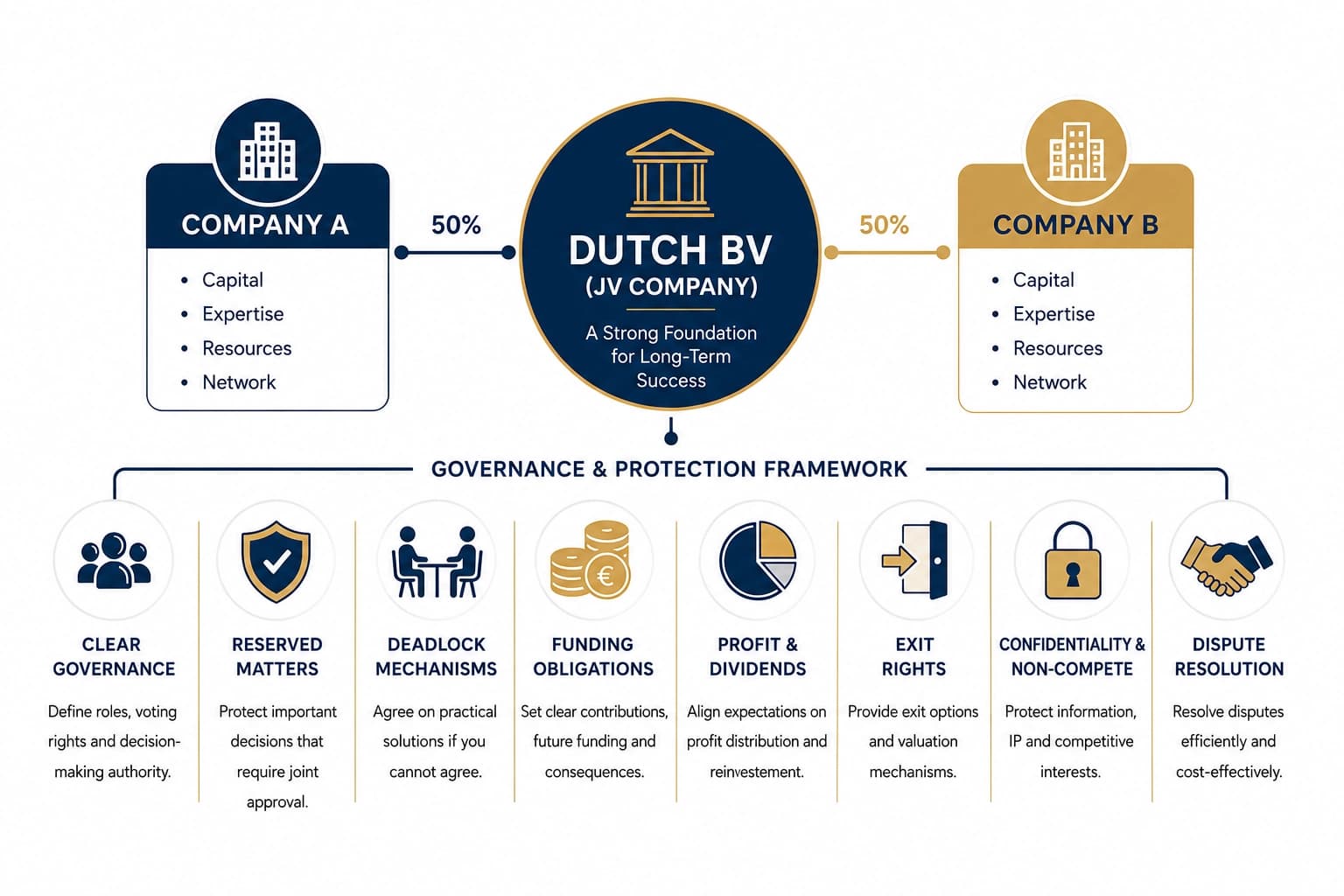
How to Structure a Dutch Joint Venture Without Creating Future Disputes
How to structure a Dutch joint venture with clear governance, shareholder rights, reserved matters, deadlock rules, and exit mechanisms to prevent future business disputes.
Introduction
A Dutch joint venture can be a powerful way to enter the Dutch market, combine expertise, share investment risk, and build long-term commercial value.
But many joint ventures fail for one simple reason:
The parties focus on the opportunity, but not enough on the governance.
At the beginning, everyone is optimistic. The business plan looks promising. The partners trust each other. The market opportunity feels urgent.
However, problems often arise later when the parties disagree about strategy, funding, profit distribution, management control, or exit timing.
A well-structured Dutch joint venture should not only explain how the business will start. It should also explain how decisions will be made, how disagreements will be handled, and how parties can exit if the relationship no longer works.
What Is a Joint Venture?
A joint venture is a commercial cooperation between two or more parties who agree to pursue a business objective together.
In the Netherlands, a joint venture is often structured through a Dutch BV, because the BV is flexible and commonly used for private companies, family businesses, investment structures, and international ventures. Dutch company law also allows different share classes, governance rights, and shareholder arrangements, which makes the BV suitable for tailored joint venture structures.
A joint venture may be used for:
Market entry into the Netherlands
Real estate projects
Technology development
Distribution partnerships
Investment platforms
Family business expansion
Cross-border commercial cooperation
Why Joint Ventures Often Lead to Disputes
Joint ventures often fail because the parties do not properly discuss difficult questions at the beginning.
Common causes of disputes include:
One party contributes more than expected
One party controls operations too strongly
Funding obligations are unclear
Profit expectations differ
One party wants to exit earlier
Strategic goals change
Deadlock mechanisms are missing
In practice, a joint venture agreement should be drafted with one question in mind:
What happens if the parties no longer agree?
Choosing the Right Dutch Structure
For many Dutch joint ventures, the BV is the preferred structure.
A Dutch BV offers:
Limited liability
Flexible share capital
Customisable governance
Possibility of different share classes
Shareholder agreement flexibility
Suitability for foreign investors
There is no general restriction preventing foreign investors from using Dutch company structures, which makes the Netherlands attractive for international joint ventures.
In some cases, a cooperative, partnership, or holding structure may also be considered, depending on tax, governance, investment, and operational needs.
Ownership Split: 50/50 Is Not Always the Best Option
Many joint venture partners choose a 50/50 ownership split because it feels fair.
But equal ownership can create serious problems.
If both parties have equal voting rights and no deadlock solution, the company may become paralysed when they disagree.
Alternative structures may include:
StructurePossible Use50/50 ownershipEqual strategic partnership51/49 ownershipOne party has final control60/40 ownershipMajority/minority investor structureDifferent share classesTailored voting or economic rightsReserved matter vetoesProtection without full control
The right structure depends on the commercial relationship, contribution level, and desired control balance.
Governance: Who Makes the Decisions?
A joint venture must clearly define decision-making authority.
Key questions include:
Who appoints directors?
What decisions can management take alone?
Which matters require shareholder approval?
Can one party block important decisions?
How often must reporting take place?
What happens if directors disagree?
Dutch companies can use articles of association and shareholder agreements to regulate governance arrangements, including appointment rights, voting arrangements, reserved matters, transfer restrictions, and information rights.
Reserved Matters: Protecting Important Decisions
Reserved matters are decisions that cannot be taken without special approval.
They are essential in joint ventures.
Typical reserved matters include:
Issuing new shares
Taking major loans
Selling important assets
Changing the business plan
Hiring or dismissing key executives
Entering major contracts
Approving annual budgets
Changing the articles of association
Dissolving the company
Entering related-party transactions
Reserved matters protect both parties by ensuring that major decisions are not made unilaterally.
Deadlock Mechanisms: Planning for Disagreement
A deadlock occurs when the parties cannot agree on an important decision.
Without a deadlock mechanism, the joint venture may stop functioning.
Common deadlock solutions include:
Escalation to senior management
Mediation
Expert determination
Rotating decision rights
Buy-sell mechanisms
Put and call options
Russian roulette or Texas shoot-out clauses
Not every mechanism suits every business. Some are too aggressive for long-term strategic partnerships. Others may work well where both parties are financially strong and commercially sophisticated.
The key is to choose a mechanism that fits the relationship.
Funding Obligations
Funding is one of the most common sources of conflict.
The agreement should clearly state:
How much each party must contribute
Whether funding is equity or debt
What happens if one party cannot contribute
Whether dilution applies
Whether shareholder loans are allowed
Who approves future financing
Without clear funding rules, one party may feel forced to carry the business while the other keeps ownership rights.
Profit Distribution and Dividend Policy
Joint venture partners may have different expectations regarding profits.
One party may want dividends.
Another may prefer reinvestment.
The agreement should explain:
When profits may be distributed
Whether reserves must be maintained
Who approves dividends
Whether business growth takes priority
How financial reporting supports dividend decisions
For Dutch BVs, distributions are subject to legal requirements and board approval, especially where the company must remain able to pay its debts.
Transfer Restrictions and Exit Rights
No joint venture lasts forever.
The agreement should explain what happens if one party wants to leave.
Important clauses include:
Lock-up periods
Right of first refusal
Tag-along rights
Drag-along rights
Call options
Put options
Change of control provisions
Exit valuation methods
A clear exit framework prevents uncertainty and reduces pressure during disputes.
Confidentiality and Non-Compete Protection
Joint ventures often involve shared know-how, customer access, commercial data, and strategic information.
The agreement should protect:
Confidential business information
Intellectual property
Customer relationships
Trade secrets
Non-solicitation obligations
Competition restrictions, where enforceable
These clauses must be drafted carefully to remain reasonable and commercially appropriate.
Practical Checklist Before Signing a Dutch JV Agreement
Before entering a Dutch joint venture, consider:
✓ Is the ownership split appropriate?
✓ Who controls daily management?
✓ Which decisions require joint approval?
✓ Are reserved matters clearly listed?
✓ Is there a deadlock mechanism?
✓ Are funding obligations clear?
✓ Is there a dividend policy?
✓ Are exit rights included?
✓ Are transfer restrictions suitable?
✓ Is confidential information protected?
✓ Are dispute resolution steps included?
✓ Are tax, accounting, and legal matters aligned?
Frequently Asked Questions
Is a Dutch BV suitable for a joint venture?
Yes. A Dutch BV is commonly used for joint ventures because it is flexible and allows customised governance arrangements.
Is a 50/50 joint venture risky?
It can be. A 50/50 structure may create deadlock if the parties disagree and no resolution mechanism exists.
What are reserved matters in a joint venture?
Reserved matters are important decisions requiring special approval, such as major financing, share issuance, asset sales, or strategy changes.
Can foreign companies own shares in a Dutch joint venture?
Yes. Foreign investors can generally own shares in Dutch companies.
What should be included in a Dutch joint venture agreement?
Key clauses include governance, funding, reserved matters, transfer restrictions, exit rights, confidentiality, deadlock rules, and dispute resolution.
How can joint venture disputes be prevented?
Most disputes can be reduced by clear governance, realistic funding rules, strong reporting obligations, and a practical exit mechanism.
Conclusion
A successful Dutch joint venture is not built only on opportunity. It is built on clarity.
The parties should know who controls what, how decisions are made, how profits are handled, what happens during disagreement, and how each party can exit if needed.
Well-designed governance does not damage trust. It protects trust.
At TAMM Solutions, we assist founders, investors, international companies, and business partners with Dutch joint venture structuring, shareholder agreements, governance frameworks, and corporate advisory support in the Netherlands. A strong joint venture structure helps prevent disputes before they begin.