The Dutch STAK Explained: How Foundations Protect Family Businesses, Investors and Voting Rights
Discover how a Dutch STAK (Stichting Administratiekantoor) protects family businesses, founders and investors. Learn how a STAK separates voting rights from economic ownership and supports corporate governance, succession planning and long-term business continuity.
The Dutch STAK Explained: How Foundations Protect Family Businesses, Investors and Voting Rights
When international entrepreneurs first hear about a Dutch STAK (Stichting Administratiekantoor), they often assume it is simply another type of Dutch foundation.
In reality, a STAK is one of the most distinctive legal structures available under Dutch law and is widely used by family businesses, founders, investors and international corporate groups to create long-term governance and protect business continuity.
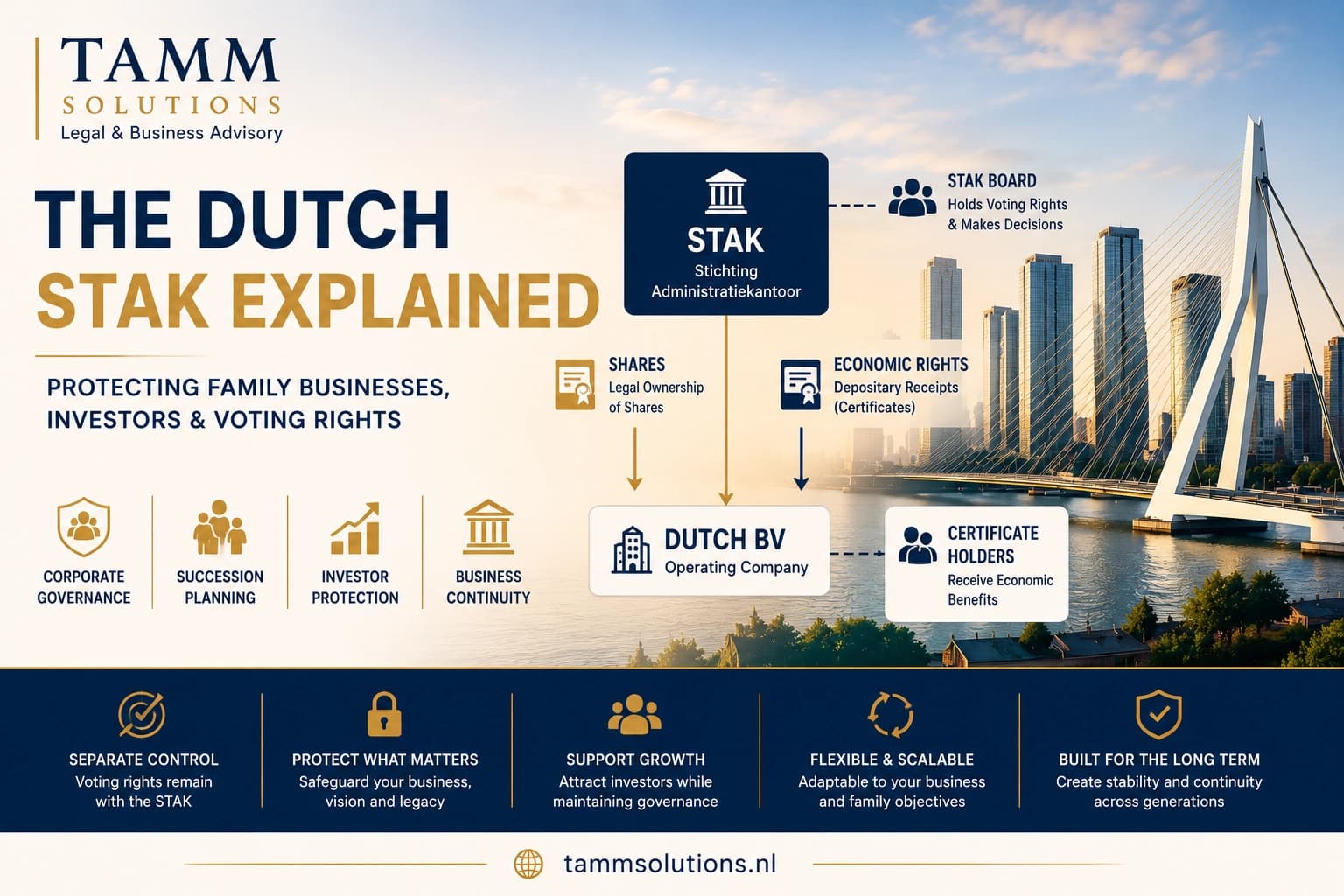
Rather than operating a business itself, a STAK is typically used to hold legal ownership of shares while allowing another party to benefit economically from those shares. This unique structure separates control from economic ownership, providing flexibility that is rarely available in many other jurisdictions.
For growing businesses, succession planning and investment transactions, a STAK can become an important corporate governance tool rather than simply another legal entity.
What Is a Dutch STAK?
A Stichting Administratiekantoor (STAK) is a specialised Dutch foundation established to administer assets, most commonly shares in a company.
Unlike an ordinary Dutch Foundation, a STAK is specifically designed to hold legal title to shares while issuing depositary receipts (certificaten) that represent the economic interests attached to those shares.
In simple terms:
The STAK becomes the legal shareholder of the company.
Investors or family members receive depositary receipts, giving them the economic benefits associated with the shares.
Voting rights generally remain with the STAK, which exercises them through its board, unless the governing documents provide otherwise.
This separation between legal ownership and economic ownership is what makes the STAK such a valuable governance instrument.
How Does a STAK Work?
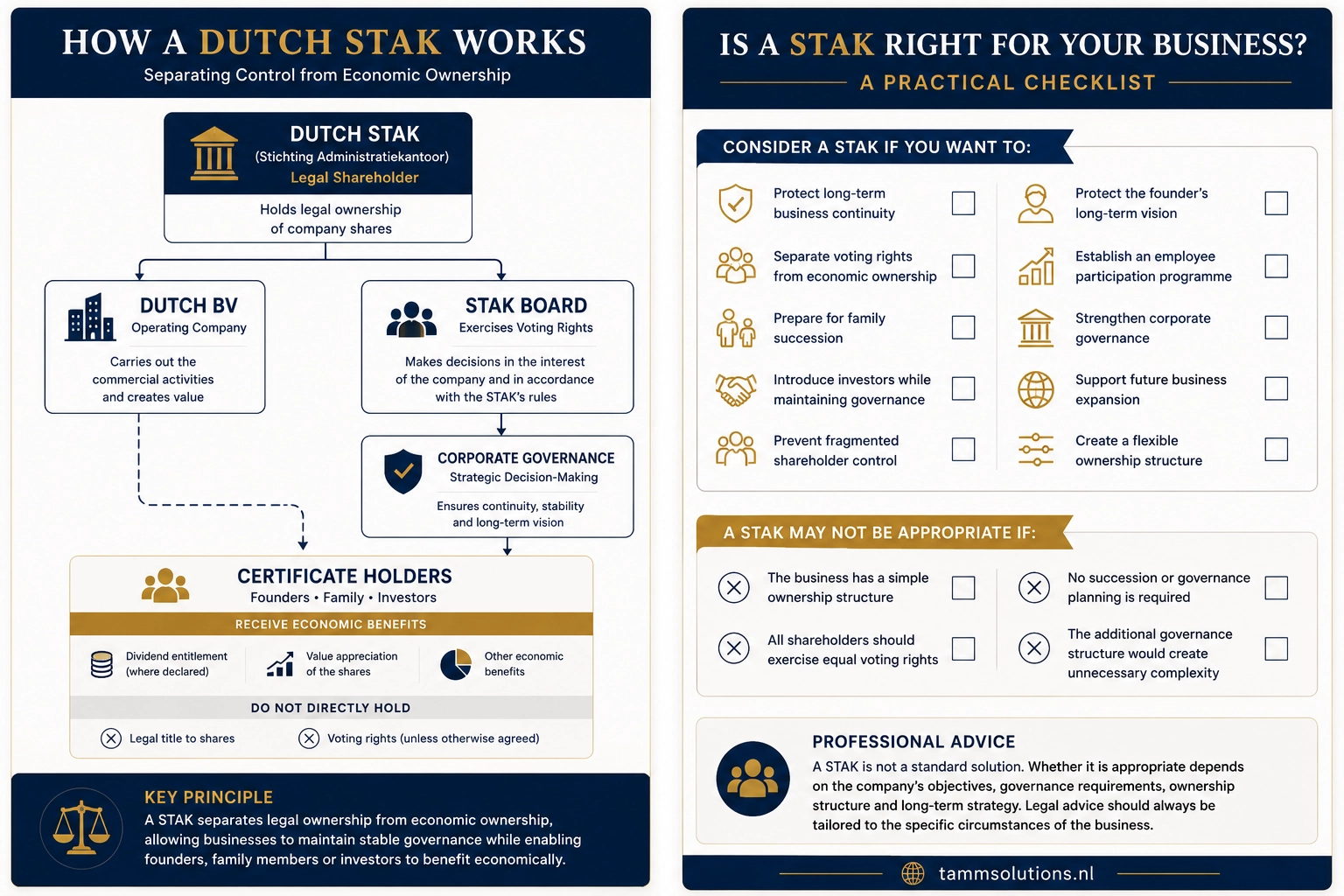
A STAK creates a structure involving three key parties:
1. The Operating Company
This is the business that carries out the commercial activities.
Examples include:
A Dutch BV
A holding company
A family business
A technology company
An investment vehicle
2. The STAK
The STAK becomes the registered shareholder of the company.
As the legal shareholder, it exercises shareholder rights, including voting at shareholders' meetings, in accordance with its governing documents and the applicable certification arrangements.
3. The Certificate Holders
Instead of holding shares directly, beneficiaries receive depositary receipts.
These certificates generally provide the economic benefits associated with the underlying shares, such as dividend entitlements where distributions are made, while voting rights remain with the STAK unless otherwise agreed.
This allows ownership and control to be managed separately.
Why Do Businesses Use a STAK?
The value of a STAK lies in governance rather than tax advantages.
Businesses often use a STAK to achieve objectives that would be difficult through ordinary share ownership.
Protecting Family Businesses
Many family businesses wish to preserve continuity across generations.
As ownership expands among children and grandchildren, decision-making can become increasingly complex.
A STAK enables the family to:
maintain stable governance;
reduce fragmentation of voting rights;
protect long-term strategy;
simplify succession.
The business continues to operate under a coordinated governance framework rather than depending on multiple individual shareholders.
Separating Control from Economic Ownership
One of the most important features of a STAK is its ability to separate:
voting rights; and
economic benefits.
For example:
A founder may wish to transfer the economic value of a company to the next generation while ensuring that strategic decisions remain centrally managed during a transition period.
Similarly, investors may receive economic participation without becoming directly involved in day-to-day governance.
This flexibility can help reduce conflict while supporting long-term business stability.
Supporting Succession Planning
Business succession is about far more than transferring ownership.
It also requires preserving effective decision-making.
A STAK can assist families in implementing gradual succession strategies by allowing future generations to participate economically while governance remains stable during the transition.
This often provides more certainty than transferring voting rights immediately to multiple successors.
Facilitating Investment
As businesses grow, they may seek external investment.
A STAK can help accommodate investment while maintaining a clear governance framework.
For example, founders may wish to:
raise capital;
reward management;
introduce strategic investors;
preserve long-term vision.
The precise structure will depend on the commercial objectives and the agreements reached between the parties.
Corporate Governance Advantages
The STAK is fundamentally a governance tool.
Properly designed governance can reduce uncertainty and support business continuity.
A STAK may contribute to:
consistent shareholder representation;
structured decision-making;
long-term business strategy;
protection against fragmented ownership;
smoother investor relations;
orderly succession.
However, governance should always reflect the particular business rather than relying on a standard template.
The Importance of Good Documentation
A STAK should never be established in isolation.
Its effectiveness depends on carefully drafted legal documentation.
Depending on the circumstances, this may include:
Articles of Association of the STAK;
Administration Conditions (Administratievoorwaarden);
Articles of Association of the company;
Shareholder agreements;
Board regulations;
Family governance arrangements;
Investment agreements.
These documents should work together to define rights, responsibilities and decision-making processes.
Common Misconceptions About a STAK
"A STAK eliminates shareholder rights."
Not entirely.
The economic interests continue to exist through the depositary receipts.
The precise rights depend on the certification arrangements and applicable legal framework.
"A STAK is only for very large companies."
No.
Although many large Dutch companies have used certification structures, STAKs are also common among privately owned companies and family businesses.
"A STAK is only about tax."
This is perhaps the biggest misconception.
In practice, a STAK is primarily a corporate governance instrument.
Its purpose is to support continuity, governance and structured ownership rather than providing tax advantages.
"The founder always keeps complete control forever."
Not necessarily.
The governance arrangements determine how directors are appointed, removed and supervised.
A well-designed STAK balances effective governance with accountability.
When Should You Consider a STAK?
A STAK may be appropriate where the objectives include:
protecting long-term business continuity;
separating voting rights from economic ownership;
supporting succession planning;
introducing investors without fundamentally changing governance;
managing family businesses across generations;
protecting strategic decision-making;
implementing employee participation programmes.
Every situation should be assessed individually.
The structure should support the commercial objectives of the business rather than becoming an unnecessary layer of complexity.
Frequently Asked Questions
What does STAK stand for?
STAK stands for Stichting Administratiekantoor, a specialised Dutch foundation commonly used to administer shares and separate voting rights from economic ownership.
Does a STAK own the company?
The STAK generally becomes the legal shareholder by holding the shares, while certificate holders retain the economic interests represented by depositary receipts.
Can investors receive dividends through a STAK?
Certificate holders may be entitled to receive economic benefits, including dividends where distributions are made, depending on the applicable documentation and the company's decisions.
Is a STAK only used by family businesses?
No.
STAKs are also used by founders, investment structures, employee participation programmes, joint ventures and privately owned companies.
Does a STAK replace a shareholder agreement?
Not necessarily.
A STAK often operates alongside shareholder agreements, articles of association and other governance documents.
Can foreign entrepreneurs establish a STAK?
Yes.
A Dutch STAK can form part of an international corporate structure where appropriate, although the suitability of the structure depends on the client's objectives and circumstances.
Conclusion
The Dutch STAK is one of the most sophisticated corporate governance tools available under Dutch law.
Rather than focusing solely on ownership, it enables businesses to create governance structures that promote continuity, protect strategic decision-making and support long-term objectives.
Whether used for family businesses, founder-led companies, succession planning or investment structures, a STAK can provide flexibility that ordinary share ownership often cannot achieve.
However, a STAK is not a standard solution. Its effectiveness depends on careful planning and properly coordinated legal documentation.
At TAMM Solutions, we advise entrepreneurs, family businesses and international investors on Dutch corporate structures, governance arrangements, shareholder relations and long-term business planning. We help clients determine whether a STAK is appropriate and, where it is, ensure that it is integrated into a wider legal framework that supports both governance and commercial success.