Why UK Businesses Continue to Choose the Netherlands as Their Gateway to Europe
Discover why UK businesses continue to choose the Netherlands as their gateway to Europe and learn the key legal issues involving Dutch company structures, corporate governance, contracts, employment, immigration, customs, accounting and compliance.
British businesses have long viewed the Netherlands as a practical base for European operations. Its central location, international commercial culture and connections to the wider EU market remain attractive. Yet geography alone does not make an expansion successful.
A Dutch presence must be legally and operationally designed around the company’s real objectives.
A UK business may need to decide whether to trade directly from Britain, register a Dutch branch or establish a separate Dutch subsidiary. It must determine which entity will sign contracts, employ staff, own intellectual property, import goods and carry business risk. It must also consider Dutch corporate governance, employment law, immigration, accounting, data protection and ongoing reporting.
The key question is therefore not simply, “Why the Netherlands?”
It is:
What Dutch legal and operational structure will allow the business to enter Europe efficiently, manage risk and grow sustainably?
This guide examines the principal legal decisions UK entrepreneurs, investors and established companies should consider before building operations in the Netherlands.
The Netherlands as a European Business Base
The Netherlands provides access to an established commercial environment within the European Union. Rotterdam’s port, Schiphol Airport and the country’s road, rail and digital networks support international trade, logistics, technology, services and e-commerce.
Its international business culture also makes it easier for UK companies to work with Dutch employees, advisers, customers and commercial partners. English is widely used in professional settings, although statutory documents, official procedures and employment requirements may still need to follow Dutch rules.
Brexit remains legally relevant, but it should no longer be treated as the main commercial story.
The United Kingdom left the EU, and the EU–UK Trade and Cooperation Agreement now forms an important part of the relationship. However, that agreement does not recreate the same level of integration that existed when the UK was an EU Member State. UK companies must therefore plan around customs, immigration, regulatory and contractual differences when conducting business in the EU.
For many companies, a Dutch operation is no longer merely a response to Brexit. It is a long-term platform for European customers, employees, investment and supply chains.
The First Legal Decision: Branch, Subsidiary or Direct Cross-Border Trading?
Before incorporating a company, the UK business should identify which legal model matches its intended activities.
The three broad options are:
trading directly from the UK;
operating through a registered Dutch branch; or
establishing a Dutch subsidiary, commonly a BV.
These structures are not interchangeable.
Operating Directly from the United Kingdom
A UK company may be able to supply certain services or products to Dutch and EU customers without establishing a permanent Dutch entity.
This may be suitable where:
activities are limited;
no Dutch employees are hired;
no permanent establishment or office is maintained;
contracts remain with the UK company;
the business is testing the market.
However, direct trading does not remove customs, VAT, consumer-law, regulatory or data-protection considerations. A business may also create Dutch registration or tax consequences depending on how activities are actually conducted.
The company should therefore examine its operational model rather than assuming that the absence of a Dutch company means the absence of Dutch obligations.
Registering a Dutch Branch
A branch is an establishment of the UK company rather than a separate legal entity.
This means that the UK company generally remains responsible for the branch’s obligations and liabilities. The branch can operate locally, but it does not create the same legal separation as a Dutch subsidiary.
A foreign company with an establishment in the Netherlands must register that establishment in the Dutch Business Register maintained by the Netherlands Chamber of Commerce, or KVK.
A branch may be appropriate where:
the UK parent wants direct control;
the Dutch operation is limited in scope;
a separate shareholder structure is unnecessary;
the business accepts that liabilities remain connected to the UK entity.
Because the UK is outside the EU, a UK legal entity with a Dutch branch may also face Dutch filing obligations concerning its financial statements where corresponding filing obligations apply in its home jurisdiction.
Establishing a Dutch Subsidiary
A subsidiary is a separate Dutch legal person. For most privately held international businesses, this will usually be a Dutch BV.
The UK parent may own all shares in the BV, or ownership may be shared with investors, management, founders or joint venture partners.
A subsidiary may provide:
separation between UK and Dutch liabilities;
a local contracting entity;
a platform for Dutch employees;
clearer local governance;
opportunities to admit investors;
greater flexibility for a future sale or joint venture.
A subsidiary also creates its own corporate, accounting and governance responsibilities. It should therefore be treated as a genuine company and not merely as a registration number.
Why UK Companies Commonly Choose a Dutch BV
The BV is a private limited liability company with legal personality. It can be established by one or more shareholders and can accommodate outside investors. Dutch official business guidance notes that a BV does not require a fixed minimum amount of starting capital.
Its flexibility makes it suitable for:
operating companies;
European sales subsidiaries;
holding structures;
joint ventures;
e-commerce operations;
technology ventures;
management participation structures;
investment platforms.
A BV can also use different governance arrangements, share classes and approval mechanisms, subject to Dutch law and its articles of association.
However, choosing a BV should follow legal analysis rather than habit.
The company must still decide:
who will own the shares;
who will act as directors;
who can represent the company;
which decisions require parent-company approval;
how the BV will be funded;
whether the BV will own or license intellectual property;
how profits may be distributed;
how the Dutch operation will report to the UK parent.
These decisions affect control, liability, transparency and future investment.
Corporate Presence Is More Than Company Registration
A common mistake is to treat incorporation as the completion of the expansion project.
In reality, incorporation is only the legal starting point.
A UK group should establish how the Dutch entity will operate in practice.
Which Entity Conducts the Business?
The group should clearly allocate:
customer contracts;
supplier agreements;
employment relationships;
intellectual property;
inventory;
insurance;
bank accounts;
licences;
invoicing;
commercial risk.
For example, a Dutch BV should not present itself as the seller while all contracts, revenue and decision-making remain informally with the UK parent.
That lack of clarity can create difficulties for customers, regulators, accountants, employees and directors.
Where Are Decisions Actually Made?
The company should also determine where management decisions take place and who has genuine authority.
Relevant questions include:
Does the Dutch board make decisions independently?
Must important matters be approved in the UK?
Which director signs contracts?
Are local directors properly informed?
Are decisions recorded through board and shareholder resolutions?
Does the governance structure match the actual conduct of the business?
The documents and day-to-day reality should be aligned. A company structure that exists only on paper is rarely a strong foundation for international expansion.
Designing the UK Parent–Dutch Subsidiary Relationship
The relationship between a UK parent and Dutch subsidiary should be properly documented.
Informal group arrangements may work while a business is small, but they often become problematic during audits, investment rounds, disputes, reorganisations or a sale.
Funding the Dutch Entity
The Dutch company may be funded through:
share capital;
share premium;
shareholder loans;
intercompany credit;
external financing.
The appropriate method will depend on the group’s legal, financial and tax position.
Funding documents should address:
amount and purpose;
repayment terms;
interest, where applicable;
security;
conversion rights;
approval requirements;
consequences of default.
Tax and transfer-pricing implications should be reviewed by qualified tax specialists where relevant.
Intercompany Services and Intellectual Property
The group may also need agreements covering:
management services;
administrative support;
software licences;
intellectual-property licences;
distribution;
marketing;
shared personnel;
data processing;
cost allocation.
These agreements help explain which company performs each function and how responsibilities and payments are allocated.
They are particularly important where the Dutch company relies heavily on technology, branding or personnel supplied by the UK parent.
Corporate Governance and Director Responsibilities
The Dutch BV has its own corporate bodies and governance framework.
Its management board is responsible for managing the company. Shareholders exercise the powers allocated to them by Dutch law and the company’s articles.
Ownership and management should not be treated as identical.
Board Authority and Shareholder Oversight
The governance framework should identify:
the composition of the board;
director appointment and removal rights;
individual or joint signing authority;
reporting duties;
conflicts-of-interest procedures;
shareholder approval rights;
internal group approvals.
Directors should understand that they act for the Dutch company. They should consider the company’s interests rather than automatically treating instructions from the UK shareholder as binding in every situation.
Reserved Matters and Group Approvals
The articles of association, shareholder arrangements or internal governance policies may identify decisions requiring additional approval.
These reserved matters may include:
major borrowing;
acquisitions;
asset sales;
new share issues;
dividend distributions;
large contracts;
changes to the business plan;
appointment of senior management;
related-party transactions;
litigation settlements.
Reserved matters create control, but they should not be so extensive that local management becomes unable to operate efficiently.
The aim is to balance oversight with workable decision-making.
Trading Between Great Britain, the Netherlands and the EU
A Dutch company can create a commercial base within the EU, but it does not automatically eliminate every border or supply-chain issue.
Customs Declarations and Importer Responsibilities
Goods moving between Great Britain and the EU are generally subject to customs procedures. EU guidance confirms that customs declarations are required for goods imported from or exported to Great Britain, with additional safety and security information potentially required.
Before goods can circulate freely within the EU customs territory, non-EU goods generally need to be presented and cleared through the relevant customs process.
The business should determine:
who is the exporter;
who is the importer of record;
who handles customs declarations;
which Incoterms apply;
who bears duties and transport costs;
where inventory is stored;
whether product-specific approvals are required;
whether rules of origin affect preferential tariff treatment.
These matters should be reflected in logistics and customer contracts.
VAT and Commercial Flows
VAT treatment depends on the actual transaction.
Relevant factors may include:
goods or services;
business or consumer customers;
customer location;
inventory location;
import arrangements;
online marketplaces;
distance sales;
fixed establishments.
The existence of a Dutch BV does not by itself answer every VAT question. The commercial flow must be mapped and reviewed with suitable accounting and tax professionals.
Reviewing Contracts for Dutch and EU Operations
UK contracts should not automatically be reused for the Dutch market without review.
A contract prepared for UK operations may contain assumptions that no longer match the European model.
The review should consider:
which group entity is the contracting party;
governing law;
jurisdiction or arbitration;
currency and payment terms;
customs costs;
delivery terms;
importer responsibilities;
warranties;
liability limitations;
regulatory compliance;
data protection;
intellectual-property ownership;
termination rights.
Distribution, Agency and E-Commerce Contracts
Distribution and agency relationships may also require review under Dutch and EU legal principles.
For e-commerce and consumer-facing activities, the business should assess:
pre-contract information;
cancellation rights;
pricing transparency;
delivery obligations;
complaints;
guarantees;
privacy notices;
cookie requirements;
marketplace responsibilities.
Dutch official business guidance confirms that businesses handling customer data must follow GDPR requirements, including having a valid basis for collecting personal information and explaining its use through appropriate privacy information.
Hiring Employees in the Netherlands
Hiring Dutch employees creates obligations that differ substantially from common UK practices.
Employment contracts should be prepared for the Dutch legal environment rather than copied from UK templates.
Dutch employers must provide required information regarding matters such as the type of contract, holiday entitlement, applicable leave, dismissal procedures, notice periods, training rights, pensions and any applicable collective labour agreement.
Employment Terms, Sickness and Dismissal
Important areas include:
fixed-term and permanent contracts;
probation;
salary and holiday allowance;
working hours;
confidentiality;
intellectual-property clauses;
non-compete restrictions;
sickness and reintegration;
dismissal procedures;
collective labour agreements;
pension obligations.
Dutch employees are generally entitled to holiday allowance of at least 8% of gross annual salary, subject to limited exceptions.
Employers may also be required to continue paying at least 70% of an employee’s wages during sickness for up to two years, while meeting reintegration obligations.
Dismissal is not simply an at-will management decision. Dutch employers generally need a valid dismissal ground and may need approval from the UWV or a court where the employee does not agree.
These obligations should be budgeted before recruitment begins.
Works Councils and Workforce Growth
As the Dutch operation grows, employee participation requirements can become relevant.
A company employing 50 or more individuals must generally establish a works council.
The works council can have consultation, advice or consent rights concerning important organisational and employment decisions. Workforce governance should therefore be planned before the company reaches the relevant size.
Moving UK Directors and Employees to the Netherlands
A UK citizen’s ability to visit the Netherlands is not the same as the right to work or reside there.
UK nationals are no longer EU citizens. Those covered by the Withdrawal Agreement may retain specific residence and work rights, but other UK nationals may need an appropriate Dutch residence or work authorisation.
Business Visits Versus Working and Residence
The company should distinguish between:
attending meetings;
negotiating contracts;
performing services;
managing daily operations;
working for the Dutch company;
relocating to the Netherlands.
A director who visits occasionally for meetings may be in a different legal position from a director who lives in the Netherlands and manages the Dutch operation full time.
Possible immigration routes may include:
highly skilled migrant status;
a combined residence and work permit;
an EU Blue Card;
an entrepreneur or start-up route;
a permit connected to the EU–UK Trade and Cooperation Agreement;
Withdrawal Agreement protection for qualifying individuals.
The appropriate route depends on the person’s role, nationality, salary, employer and activities. IND guidance lists various work-related residence permits and confirms that paid employment may require a combined residence and work permit in relevant cases.
Immigration planning should therefore take place before relocation or employment begins.
Accounting, Reporting and Corporate Housekeeping
A Dutch company must maintain proper administration throughout its life.
The required framework may include:
accounting records;
annual accounts;
corporate tax and VAT filings;
payroll;
board resolutions;
shareholder resolutions;
shareholder-register maintenance;
UBO records;
KVK updates;
intercompany documentation.
BVs are among the Dutch legal entities generally required to file annual financial statements with KVK.
Dutch legal entities must also identify and register their ultimate beneficial owners where the UBO rules apply.
Changes involving directors, addresses, ownership or authority should be recorded and reported promptly. Dutch official guidance states that board changes should be notified to KVK and warns that former directors who remain registered may continue to face risks.
Good corporate housekeeping is not a box-ticking exercise. It creates reliable records for investors, banks, auditors, counterparties and future purchasers.
Data Protection, Intellectual Property and Confidential Information
A Dutch operation may process customer, employee, supplier or website-user data.
A business established in the EU that processes personal data must comply with the GDPR, regardless of where the technical processing takes place.
The group should consider:
which entity acts as controller;
which companies act as processors;
international data transfers;
privacy notices;
employee data;
security measures;
data-processing agreements;
breach procedures;
retention periods.
Intellectual property should also be clearly allocated.
Where software, trademarks, designs, databases or commercial materials are created within the group, the company should document:
legal ownership;
licences;
permitted use;
development rights;
confidentiality;
post-termination restrictions.
Unclear IP ownership can seriously reduce the value of a company during investment or sale.
Sector-Specific Licensing and Regulatory Checks
Incorporating a Dutch BV does not automatically authorise every business activity.
Additional rules may apply in sectors such as:
financial services;
recruitment and staffing;
transport;
healthcare;
food;
pharmaceuticals;
construction;
energy;
consumer credit;
regulated professions;
import and export;
telecommunications.
A business may need permits, registrations, product approvals, professional qualifications or sector-specific compliance systems.
These checks should be completed before signing leases, hiring staff, importing products or making binding customer commitments.
Common Legal Mistakes Made During Dutch Expansion
1. Choosing a BV Without Comparing It With a Branch
A BV may be suitable, but the decision should follow an analysis of liability, staffing, contracting, governance and reporting.
2. Using UK Contracts Without Dutch or EU Review
Employment, consumer, distribution and data-protection terms may need local adaptation.
3. Failing to Separate the UK and Dutch Businesses
Mixing invoices, contracts, employees, assets and decision-making can undermine clarity.
4. Leaving Intercompany Arrangements Undocumented
Management services, loans, IP use and cost allocations should not remain informal.
5. Giving Directors Titles Without Defining Authority
The company should clarify signing rights, reporting lines and approval limits.
6. Treating Employment Costs as Salary Only
Sickness, holiday allowance, dismissal procedures, pensions and payroll obligations can significantly affect costs.
7. Relocating Staff Before Confirming Immigration Status
Business travel does not necessarily permit employment or long-term residence.
8. Assuming a Dutch Company Removes Customs Formalities
The full movement of goods still needs to be analysed.
9. Ignoring Ongoing Corporate Administration
Late filings and weak corporate records can damage credibility and create legal risk.
10. Seeking Advice Only After Operations Begin
It is usually easier and less expensive to design the structure correctly before contracts, staff and liabilities accumulate.
Practical Netherlands Expansion Checklist
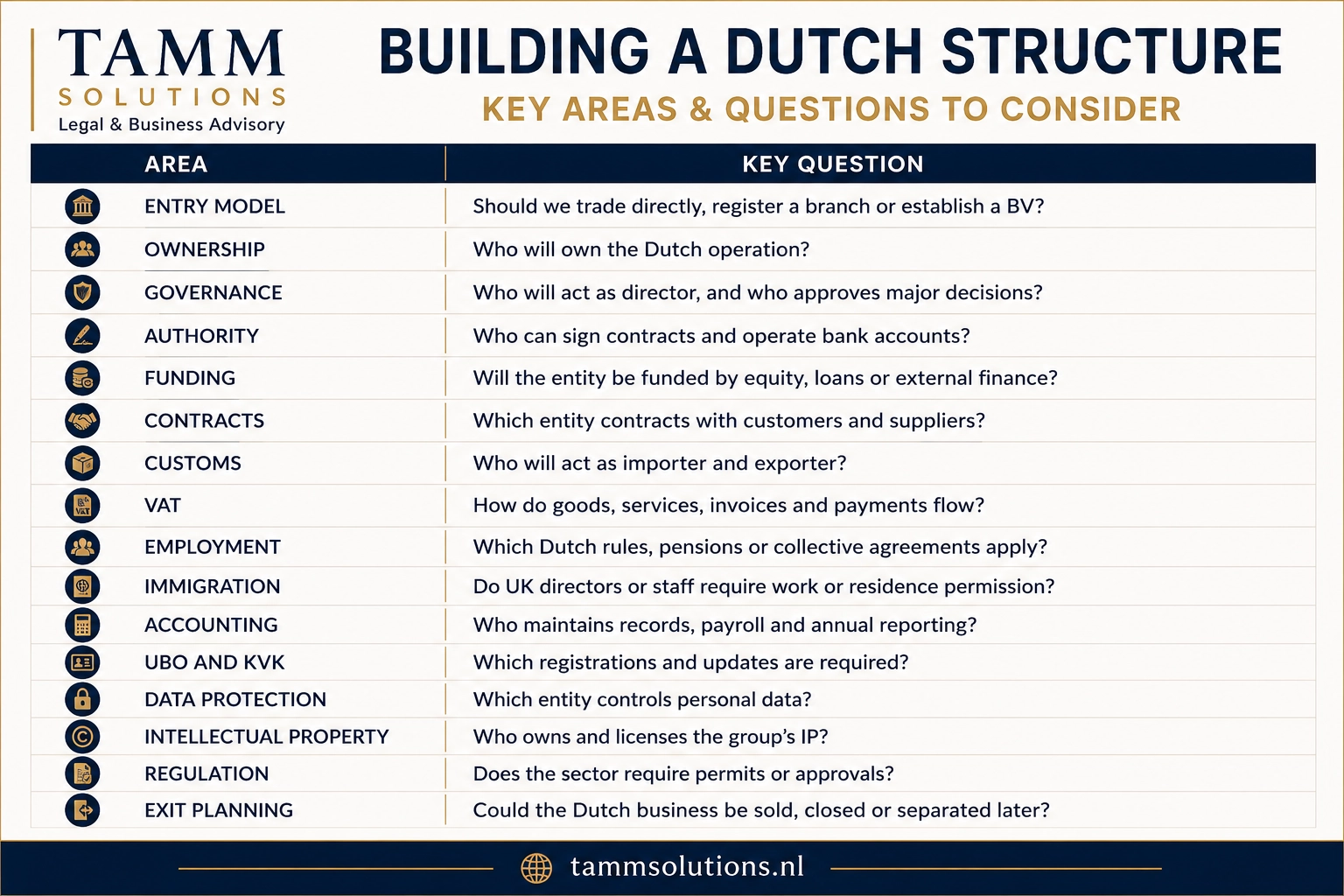
Before entering the Dutch market, a UK business should consider the following:
Frequently Asked Questions
Can a UK company trade in the Netherlands without forming a Dutch company?
Potentially, yes. The answer depends on its activities, physical presence, staff, contracts, regulatory position and tax treatment. A foreign business with an establishment in the Netherlands must generally register that establishment with KVK.
What is the difference between a Dutch branch and a BV?
A branch is part of the UK company and is not a separate legal entity. A BV is a separate Dutch legal person with its own governance, accounting and liabilities.
Does a Dutch BV need a Dutch address?
A company registering in the Dutch Business Register generally needs a Dutch business address.
Can a UK company own 100% of a Dutch BV?
Yes. A Dutch BV may have a single corporate shareholder, including a UK parent company.
Will a Dutch BV remove all customs formalities between the UK and EU?
No. Goods moving between Great Britain and the EU remain subject to customs rules. The company must still determine who imports, exports, declares and bears the relevant costs.
Can UK employees work for the Dutch business automatically?
Not necessarily. UK nationals who are not protected by the Withdrawal Agreement may require appropriate work and residence permission, depending on their activities and length of stay.
Does a Dutch BV have to file annual accounts?
Dutch BVs are generally required to prepare and file annual financial statements with KVK, subject to the applicable reporting rules and deadlines.
Should the UK parent and Dutch subsidiary sign written agreements?
Usually, yes. Loans, services, intellectual-property use, staff sharing, distribution and data processing should be documented where relevant.
Conclusion
Why UK Businesses Continue to Choose the Netherlands as Their Gateway to Europe is not answered only by location, transport links or international culture.
The stronger answer lies in what the Netherlands can provide when the expansion is structured properly: a recognised Dutch company, a clear governance model, an EU contracting platform, access to local employees and a reliable foundation for European growth.
However, a Dutch company is not a complete market-entry strategy by itself.
UK businesses must decide how the Dutch operation will be owned, managed, funded and connected to the parent company. They must align contracts, customs, employment, immigration, accounting, data protection and corporate reporting with the real commercial model.
At TAMM Solutions, we support entrepreneurs, investors and international businesses with integrated legal and business advisory services in the Netherlands. Our work includes corporate structuring and governance, commercial arrangements, employment and immigration matters, accounting and reporting coordination, and ongoing corporate compliance.
A carefully designed Dutch operation does more than create access to Europe. It creates a structure capable of supporting growth, investment and long-term commercial stability.
This article provides general information and is not a substitute for advice tailored to a specific company, transaction or immigration situation.